

2026 PSLE Situational Writing: Answering Techniques to Help You Score Full Marks
In 2025, the mark allocation for Situational Writing dropped ever so slightly - from 15 marks to 14 marks. Despite this, Situational Writing is still one of the components that is the easiest to score in, if you know how to approach it and what to look out for.
The objective of the Situational Writing component is to test your ability to write effectively, suiting the purpose, audience and context of the task required, and use appropriate vocabulary to express your points in an organised manner.
In this post, we will explore how to:
Analyse the task requirements using PACF
Identify the content points you can use from the stimulus itself
Brainstorming points for the underlined bullet point (new 2025 format)
Distinctive language notes for formal and informal writing pieces
1.PACF Question Analysis
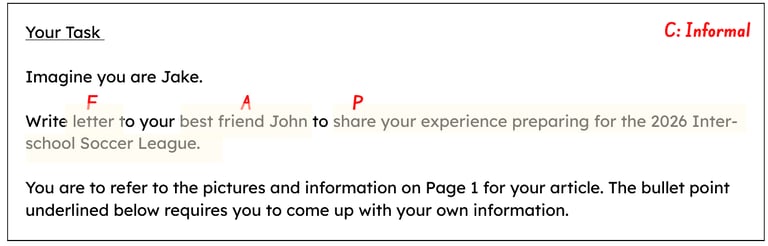
When faced with the task, students need to be able to identify the:
Purpose
Audience
Context
Format
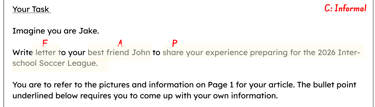
The purpose verb should be utilised in the very first paragraph, and identifying the audience will help you to understand your context - whether it should be a formal or informal piece of writing. Lastly, following the required format (e.g. article, report, letter, email) is essential.
Take a look at the task analysis that our students learn to do every time they approach situational writing!
2.Identifying Content Points from the Stimulus
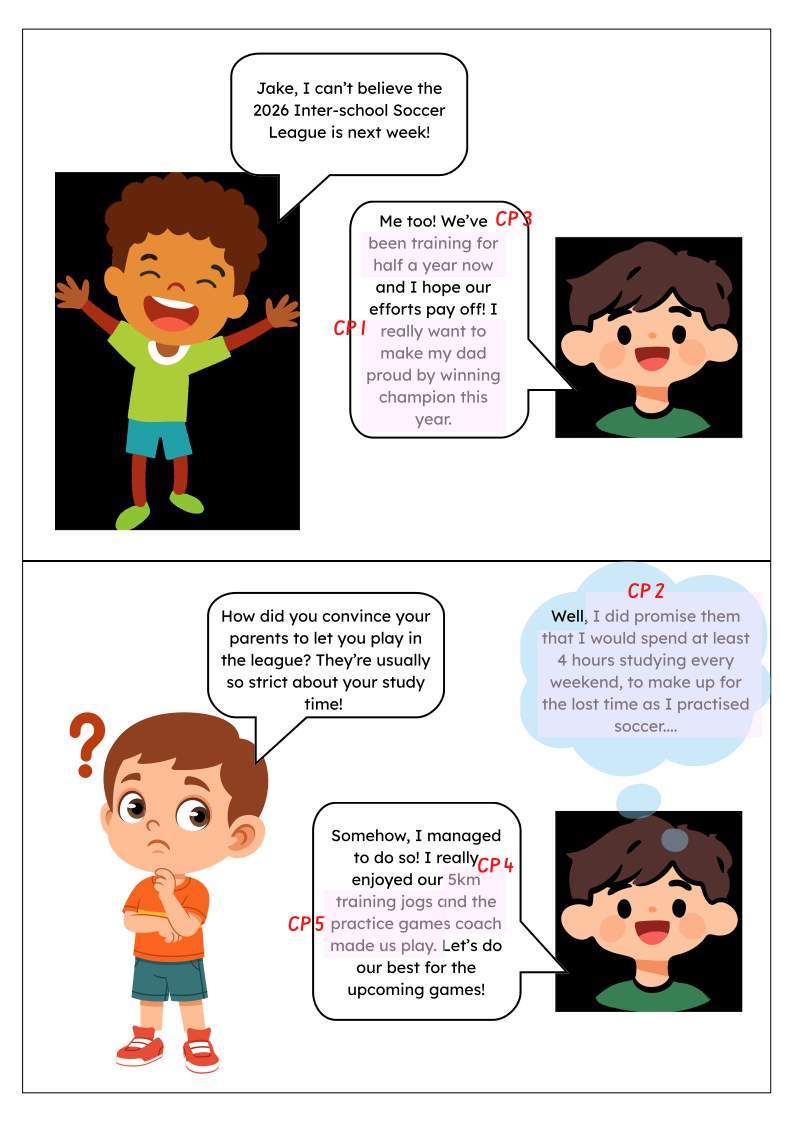
Detail-orientedness is key here! For 5 of the 6 bullet points, the details can be found in the visual stimulus itself. Identifying the correct details and including them in your answer will help you to score in your task fulfilment.
Here, you can see how our students are encouraged to highlight all relevant points in the visual stimulus, and tick them once they’ve included the points in their answer.
3.The Underlined Bullet Point
By now, many students would have encountered the underlined bullet point in the Situational Writing task. Many students approach this with some trepidation, because the information cannot be found in the visual stimulus. The content of this bullet point must be something that the students suggest based on logical inference of the text and analysis of the given situation.
Although it is daunting at first glance, this little change prepares students for real world contexts more effectively, where they are increasingly expected to make strong inferences and logical conclusions to help inform their understanding of the world around them.
Some ways you can approach this bullet point are to:
Relate to your own experience:
Have you experienced something similar before, and how did you react to the situation?
Relate to someone else’s experience:
Has anyone around you mentioned something similar before, and how did they react to the situation?
Relate to stories from the world around you:
Have you heard of something similar in the news, online (e.g. Youtube, Tiktok, Instagram), or in the media (e.g. stories, movies) before, and how did those people react to the situation?
4.Using Appropriate Language
8 out of 14 marks have been allocated to Language and Organisation. Asides from the usual grammar, punctuation and spelling to look out for, you also need to pay attention to the following!
(i) Context: Formal vs Informal Language
(ii) Format: Email, Article, Report, Speech, Letter, Email, Proposal
(iii) Signposts and Connectors
Sequence: Firstly, Secondly, Thirdly
Adding to previous points: To add on, In addition, Also,
Contrasting previous points: However, On one hand… On the other hand…
Found this blogpost helpful? Send it to your friends and family so that we can all prepare for PSLE English together! (:
Pages
Home
Programmes
About
Blog
© 2026. All rights reserved.